Langfuse v4 is live: faster at scale, with more ways to search, monitor, and evaluate
 Max Deichmann
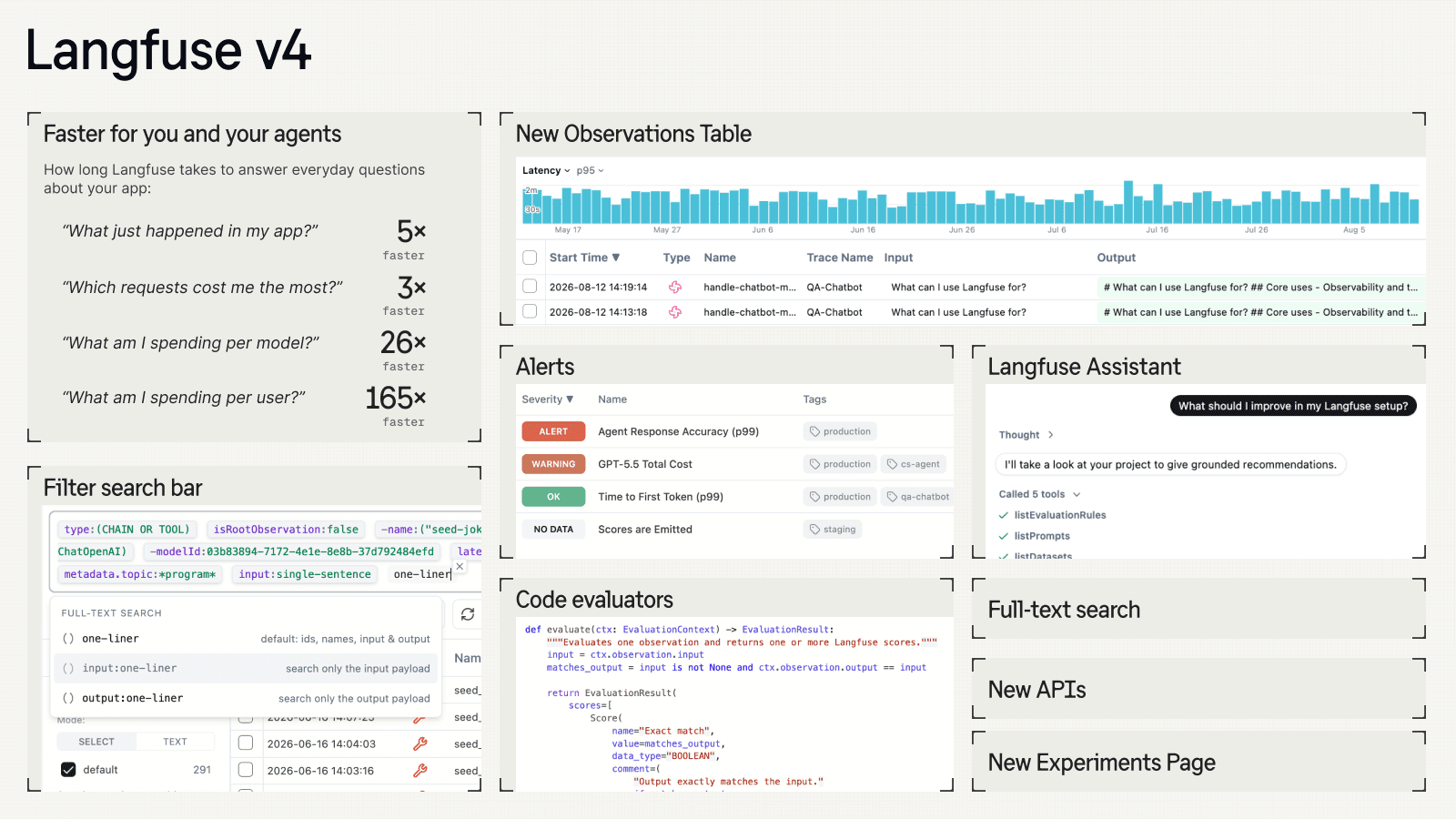
Query and evaluate every agent step directly, with initial table loads in milliseconds and at least 10x faster dashboards for large projects.
Langfuse v4 is live on Langfuse Cloud and generally available for self-hosted deployments. It makes it faster to debug, evaluate, and monitor complex LLM applications by letting you work with every LLM call, tool execution, and agent step directly. Initial table loads over large datasets drop from seconds to milliseconds, and dashboards over longer time ranges load at least 10x faster in large projects.
Langfuse Cloud becomes v4-only on November 16, 2026 (2026-11-16). Most projects need no migration. If the Migration Assistant shows actions for your project, complete them before this date.
New to Langfuse
There is nothing to migrate. Start tracing with the v4 data model.
Using Langfuse Cloud
Open the Migration status page and complete only the checks detected for your project.
Self-hosting Langfuse
Plan the upgrade on your schedule and review the infrastructure requirements first.
What we shipped in Langfuse v4
Langfuse v4 brings faster performance and new ways to build, debug, and evaluate AI applications. Here are the highlights from v4 and the releases since launch.
AI Gateway (beta)
Route model calls through Langfuse, manage provider access, and track usage and cost by user, key, and model.
Skill Management (beta)
Version agent skills alongside prompts and connect skill versions and loaded files to your traces.
Enhanced evals
Evaluate with deterministic Python or TypeScript checks and decision models.
Search and filtering
Combine full-text search, metadata, and score filters in one shareable query.
Trace and session views
Read conversations more easily with a cleaner session view and an improved trace timeline.
Alerts
Watch cost, quality, and latency thresholds. Notify your team through Slack, PagerDuty, webhooks, or GitHub Actions.
Pulse and charts
Spot cost, latency, and volume outliers, then investigate the underlying observations or save charts to dashboards.
Halo
Ask questions about traces, observations, sessions, and metrics in plain language.
Observations and Metrics APIs
Retrieve observations with cursor-based pagination or aggregate cost, usage, latency, and scores through the v2 APIs.
These are the highlights. See the full changelog for SDK releases, integrations, security updates, and more.
Upgrade Langfuse Cloud projects
Langfuse Cloud deprecates v3 endpoints and features on November 16, 2026 (2026-11-16). Please complete any migration requirements for your projects before this date.
New projects already use v4 and need no migration.
For existing projects, organization owners can open the Migration Assistant sidebar and the Migration status page to see if any actions are required:

We will email project owners and admins a summary of the actions required for their projects. Complete those actions by November 16, 2026 (2026-11-16).
Follow the upgrade guide for more details.
Upgrade self-hosted Langfuse instance
Langfuse v4 is generally available for self-hosted deployments. There is no forced cutover date, and Langfuse v3 will receive security patches through January 2027.
Follow the self-hosted v3 to v4 migration guide to review the infrastructure requirements and plan your upgrade.
Technical background: V4 does less work for the same query
- Queries scan less data. One denormalized observations table replaces read-time joins between traces and observations.
- Ingestion writes less data. Each completed observation is written once.
- Immutable data creates room to optimize. Append-only observations give us the architectural freedom to introduce optimizations such as materialized views in the future.

Older SDKs sent updates to both traces and observations, which we stored in separate tables. Before ClickHouse could return a result, it had to join those tables and deduplicate the updates. This was slow at scale.
The Langfuse Python SDK 4.7.0 or later and JS/TS SDK 5.4.0 or later add trace-level attributes such as user_id and session_id to every observation before it is ingested into Langfuse. Each observation is written to a new immutable, append-only table. The same query now needs neither a join nor deduplication, which makes it much faster.
Questions
Ask rollout and migration questions via the in-app support form or on the v4 GitHub Discussion post.
You can also join a live Q&A with the Langfuse engineering team. Bring migration questions or your actual setup:
| Date | Americas | Europe | Asia | Registration |
|---|---|---|---|---|
| Wed, Aug 19 | 12:00 AM PT / 3:00 AM ET | 9:00 AM CEST | 12:30 PM IST / 3:00 PM SGT | Register |
| Wed, Aug 19 | 9:00 AM PT / 12:00 PM ET | 6:00 PM CEST | 9:30 PM IST / Thu, Aug 20, 12:00 AM SGT | Register |
| Tue, Aug 25 | 12:00 AM PT / 3:00 AM ET | 9:00 AM CEST | 12:30 PM IST / 3:00 PM SGT | Register |
| Tue, Aug 25 | 9:00 AM PT / 12:00 PM ET | 6:00 PM CEST | 9:30 PM IST / Wed, Aug 26, 12:00 AM SGT | Register |