🪢 Knot emoji: meaning, and why it's the Langfuse logo
🪢 is the knot emoji: a rope tied into a secure loop, added to Unicode in 2020. People use it for literal knots, for tying things together, and for commitments like "tying the knot". It is also the logo of Langfuse, the open-source LLM engineering platform whose website you are reading right now. Both facts explain each other, and this page covers both.
To copy it: 🪢
What the knot emoji means
The knot emoji shows a length of rope tied into a knot, most commonly rendered as a figure-eight or square knot on an orange or brown rope. Common uses:
- Literal knots and rope work. Sailing, climbing, scouting, and craft contexts use it for actual knots.
- Tying things together. The metaphorical use: connecting parts into one whole, which is the sense Langfuse borrows.
- "Tying the knot." Engagements and weddings, often next to 💍.
- Strength and security. A knot holds; the emoji signals something firmly connected.
Technical facts, as of July 2026:
| Property | Value |
|---|---|
| Character | 🪢 |
| Unicode name | Knot |
| Codepoint | U+1FAA2 |
| Added in | Unicode 13.0 / Emoji 13.0 (2020) |
| Category | Objects |
Why 🪢 is the Langfuse logo
Langfuse started in Y Combinator's W23 batch, and the founders worked through several product ideas before landing on Langfuse. Each idea got its own emoji as a working label. When the team settled on building an LLM engineering platform, the knot fit: Langfuse ties together the activities of AI engineering, from tracing to evaluation to prompt management and team collaboration, into one platform. The name works in the same direction: a fuse joins two things, and so does a knot.
There was a second reason, offered with a wink: every serious open source project needs an emoji. The 🦜🔗 of LangChain, the 🦙 of LlamaIndex, and the 🤗 of Hugging Face had set the convention for the LLM ecosystem, and Langfuse joined it. The GitHub repository has carried the 🪢 in its title since the beginning.
From emoji to logo
The Langfuse logo has evolved over time, and every version keeps the original knot emoji at heart. The first icon traced the emoji's two interlocking ropes with bold outlines; the current icon keeps the same knot and drops the outlines for a softer mark. The official assets live on the brand page.
The knot emoji
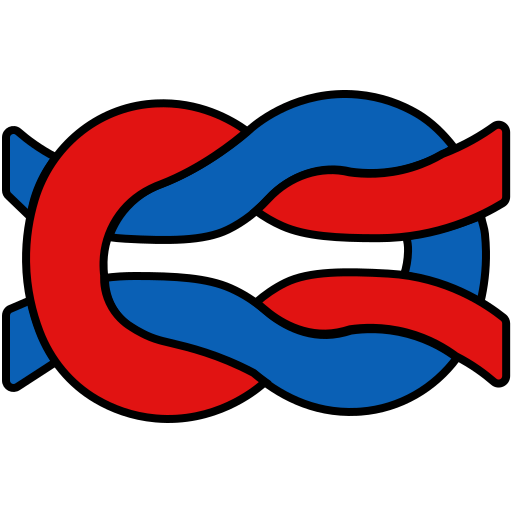
First icon
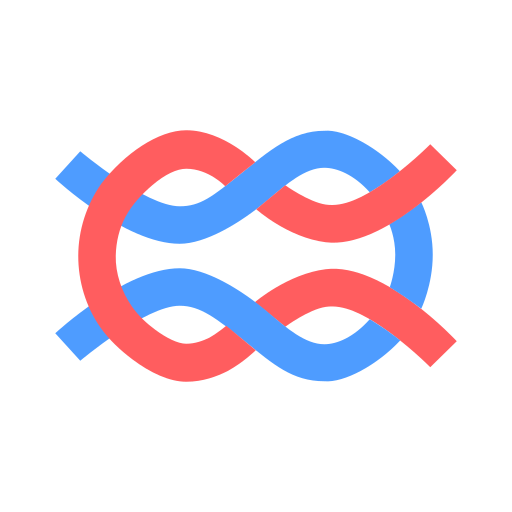
Current icon
Emoji as developer branding
An emoji logo does real work for an open source project. It renders identically in a GitHub README, a terminal, a package description, and a chat message, places where an image logo cannot follow. It costs nothing to reproduce, survives copy-paste, and makes a project recognizable in a plain-text dependency list. The convention is now strong enough in the LLM tooling ecosystem that the emoji often precedes the name, as in "🪢 Langfuse".
FAQ
What does the 🪢 emoji mean?
🪢 is the knot emoji, showing a rope tied into a knot. It is used for literal knots, for the idea of tying or holding things together, and for engagements ("tying the knot"). In the LLM tooling world it also identifies Langfuse, which uses it as a logo.
How do I copy the knot emoji?
Select and copy this character: 🪢. It is a standard Unicode character (U+1FAA2), so it pastes anywhere Unicode text works, including code comments, READMEs, and commit messages.
When was the knot emoji added to Unicode?
The knot was added as part of Unicode 13.0 and Emoji 13.0 in 2020. Platforms rolled out support over the following year, so it renders on all current operating systems and browsers.
Why does Langfuse use a knot as its logo?
Langfuse ties together the parts of AI engineering: tracing, evaluation, prompt management, and team collaboration in one open-source platform. The knot is that idea in a single character, and it doubles as the project's emoji in the tradition of 🤗 and 🦙.