Introducing Langfuse Academy
 Lotte
Lotte Annabell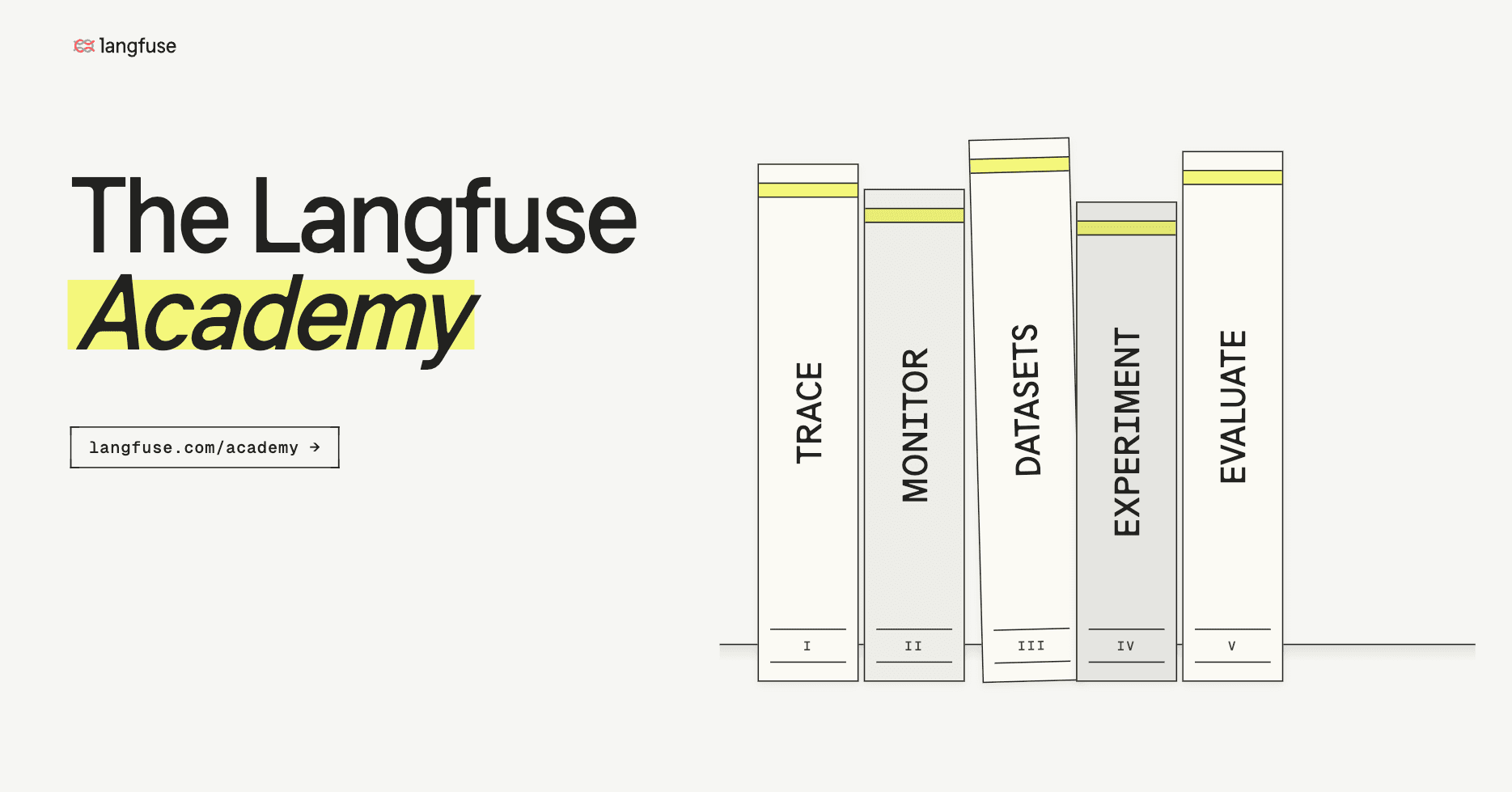
Langfuse Academy is our open explanation of the AI engineering lifecycle: tracing, monitoring, datasets, experiments, and evaluation, and how the pieces fit together.
Today we're launching the Langfuse Academy, a free, open resource that explains the AI engineering lifecycle and how the parts connect.
Why we built it
This is a new field, and users have often asked where they should start. Common practices have emerged over the past years, but the vocabulary and workflows are spread across blog posts, product docs, and teams internally. The Academy is our attempt to put them in one place.
The tooling only helps if the underlying ideas are clear. Teams move faster when AI engineers, product managers, and leadership share the same vocabulary for tracing, evaluation, datasets, and experiments.
Who is this for
The Academy is written to be useful for AI engineers and software engineers building LLM applications, for PMs reasoning about quality and tradeoffs, for technical and business leaders who want a working understanding of how AI systems are improved, and for AI agents that support humans in doing this work.
What's in the Academy today
The Academy follows the AI engineering loop from first visibility into production behavior through to structured improvement:
Each page explains why a step exists, what problem it solves, and how it connects to the next one. You can read the full sequence or jump to the topic that is most relevant to your team right now.
What's next
We plan to keep expanding the Academy with deeper dives on individual topics, more examples, and guides to put this into practice. Over time we want it to be the resource we wish had existed when we started building Langfuse.
Try it out and tell us what you think
You can find the Academy at langfuse.com/academy.
We're just getting started here and are very curious to hear what you think. If something is unclear, if a topic is missing, or if you'd approach a step differently, we'd love for you to open an issue on GitHub. Your feedback will directly shape what we publish next.