Evaluate and Improve Structured Extraction
Most production extraction is not an agent. An invoice, insurance claim, KYC packet, or bank statement goes in. A nested object comes out. You have labels, you need accuracy per field, and you will run this loop many times. The same eval applies to any document or content extraction pipeline, including when extraction is a step inside an agent.
This cookbook runs that loop on insurance claims:
- Upload a dataset of claim text plus the expected nested object
- Score every output field, plus overall accuracy
- Change one lever, remeasure, and catch a regression the pooled score hid
Stack: OpenAI structured outputs, Langfuse Tracing, Experiments, and Prompt Management.
Credits. Dataset, schema, and baseline comparison are adapted from Cleanlab's structured-output benchmark (repo, dataset). Their
schema.pyis our descriptive schema. The scorer extends theirutils.pycomparison with typed date/number matching and object pairing.
1. Setup
Install the dependencies, then set your Langfuse and OpenAI keys in the next cell.
%pip install -q "langfuse>=4.14" "openai>=3" pydantic pandas
import os

# Langfuse: project Settings → API Keys → https://cloud.langfuse.com
os.environ.setdefault("LANGFUSE_PUBLIC_KEY", "pk-lf-...")
os.environ.setdefault("LANGFUSE_SECRET_KEY", "sk-lf-...")
os.environ.setdefault("LANGFUSE_BASE_URL", "https://cloud.langfuse.com")  # 🇪🇺 EU region
# 🇺🇸 US region: https://us.cloud.langfuse.com

# OpenAI: https://platform.openai.com/api-keys
os.environ.setdefault("OPENAI_API_KEY", "sk-proj-...");
from langfuse import get_client

langfuse = get_client()
assert langfuse.auth_check(), "Langfuse auth failed. Check your keys and host."
print("Langfuse auth OK")
You should see Langfuse auth OK. Next you define the schema the model must fill.
2. Schema as the extraction contract
The schema is part of the pipeline. It constrains structured generation through OpenAI structured outputs and defines what the scorer checks. Each claim has header, optional policy_details, optional insured_objects[], and incident_description.
Two variants, same fields, so the first improvement round can change one thing:
- bare: types and constraints only. The V1 floor.
- descriptive: the same fields plus
description=text for ID formats. This is the contract you would ship.
from __future__ import annotations
from datetime import date
from typing import List, Literal, Optional
from pydantic import BaseModel, ConfigDict, Field

# ---- shared enum aliases (defined once -> both variants stay identical) -------
Channel = Literal["Email", "Phone", "Portal", "In-Person"]
CoverageType = Literal["Property", "Auto", "Liability", "Health", "Travel", "Other"]
ObjectType = Literal["Vehicle", "Building", "Person", "Other"]
IncidentType = Literal[
    "rear_end_collision", "side_impact_collision", "head_on_collision", "parking_lot_collision",
    "house_fire", "kitchen_fire", "electrical_fire", "burst_pipe_flood", "storm_damage", "roof_leak",
    "slip_and_fall", "property_injury", "product_liability", "theft_burglary", "vandalism",
]
LocationType = Literal[
    "intersection", "highway", "parking_lot", "driveway", "residential_street",
    "residence_interior", "residence_exterior", "commercial_property", "public_property",
]
_STRICT = ConfigDict(extra="forbid")
# ---- BARE variant: structure + constraints only ------------------------------
class ClaimHeaderBare(BaseModel):
    model_config = _STRICT
    claim_id: str
    report_date: date
    incident_date: date
    reported_by: str = Field(..., min_length=1)
    channel: Channel

class PolicyDetailsBare(BaseModel):
    model_config = _STRICT
    policy_number: str
    policyholder_name: str = Field(..., min_length=1)
    coverage_type: CoverageType
    effective_date: date
    expiration_date: date

class InsuredObjectBare(BaseModel):
    model_config = _STRICT
    object_id: str
    object_type: ObjectType
    make_model: Optional[str] = None
    year: Optional[int] = None
    location_address: Optional[str] = None
    estimated_value: Optional[int] = None

class IncidentDescriptionBare(BaseModel):
    model_config = _STRICT
    incident_type: IncidentType
    location_type: LocationType
    estimated_damage_amount: Optional[int] = None
    police_report_number: Optional[str] = None

class InsuranceClaimBare(BaseModel):
    model_config = _STRICT
    header: ClaimHeaderBare
    policy_details: Optional[PolicyDetailsBare] = None
    insured_objects: Optional[List[InsuredObjectBare]] = None
    incident_description: IncidentDescriptionBare
# ---- DESCRIPTIVE variant: same structure + rich descriptions (the "spec") ----
class ClaimHeader(BaseModel):
    model_config = _STRICT
    claim_id: str = Field(..., description="Claim ID in format CLM-XXXXXX, where X is a digit")
    report_date: date = Field(..., description="Date claim was reported (ISO 8601)")
    incident_date: date = Field(..., description="Date incident occurred (ISO 8601)")
    reported_by: str = Field(..., min_length=1, description="Full name of person reporting the claim")
    channel: Channel = Field(..., description="Channel used to report the claim")

class PolicyDetails(BaseModel):
    model_config = _STRICT
    policy_number: str = Field(..., description="Policy number in format POL-XXXXXXXXX, where X is a digit")
    policyholder_name: str = Field(..., min_length=1, description="Full legal name on the policy")
    coverage_type: CoverageType = Field(..., description="Type of insurance coverage")
    effective_date: date = Field(..., description="Policy effective start date (ISO 8601)")
    expiration_date: date = Field(..., description="Policy expiration end date (ISO 8601)")

class InsuredObject(BaseModel):
    model_config = _STRICT
    object_id: str = Field(..., description=(
        "Unique identifier for the insured object. For vehicles use VIN format "
        "(e.g., VIN12345678901234567). For buildings use PROP-XXXXXX. For liability use "
        "LIAB-XXXXXX. Otherwise use OBJ-XXXXXX, where X is a digit"))
    object_type: ObjectType = Field(..., description="Type of insured object")
    make_model: Optional[str] = Field(None, description=(
        "Make and model for vehicles (use standardized manufacturer names and models), "
        "or building type for property"))
    year: Optional[int] = Field(None, description="Year for vehicles or year built for buildings")
    location_address: Optional[str] = Field(None, description="Full street address where object is located")
    estimated_value: Optional[int] = Field(None, description="Estimated value in USD, no currency symbol")

class IncidentDescription(BaseModel):
    model_config = _STRICT
    incident_type: IncidentType = Field(..., description="Specific standardized incident type")
    location_type: LocationType = Field(..., description="Standardized location type where it occurred")
    estimated_damage_amount: Optional[int] = Field(None, description="Estimated damage in USD, no symbol")
    police_report_number: Optional[str] = Field(None, description="Police report number if applicable")

class InsuranceClaim(BaseModel):
    model_config = _STRICT
    header: ClaimHeader = Field(..., description="Basic claim information")
    policy_details: Optional[PolicyDetails] = Field(None, description="Policy information if available")
    insured_objects: Optional[List[InsuredObject]] = Field(None, description="Insured objects, if applicable")
    incident_description: IncidentDescription = Field(..., description="Structured incident details")

SCHEMAS = {"bare": InsuranceClaimBare, "descriptive": InsuranceClaim}
# Peek at the strict JSON schema OpenAI will enforce.
from openai.lib._pydantic import to_strict_json_schema
strict = to_strict_json_schema(InsuranceClaim)
print("sections:", list(strict["properties"].keys()))
print("incident_type enum:", len(IncidentType.__args__), "values | location_type:", len(LocationType.__args__))
You should see four sections. insured_objects is a list. That is why the scorer pairs objects before it scores their fields.
3. Upload a labeled dataset
30 synthetic claims from the Cleanlab structured-output benchmark, uploaded as a Langfuse dataset. Each item is claim text in input, the nested label in expected_output, and slices in metadata (has_policy, n_objects). The text is LLM-generated. Treat this as a demo set.
import ast
import pandas as pd

DATA_URL = "https://huggingface.co/datasets/Cleanlab/insurance-claims-extraction/resolve/main/insurance_claims_extraction.csv"
df = pd.read_csv(DATA_URL)
print("rows:", len(df), "| columns:", list(df.columns))
example_gt = ast.literal_eval(df["ground_truth"].iloc[0])   # ground_truth is a stringified dict
print("ground-truth sections:", list(example_gt.keys()))
You should see 30 rows and the four ground-truth sections. Next you attach metadata slices and upload.
The next cell derives has_policy and n_objects for each item. Expand if you want the helpers.
Dataset slice helpers
def count_leaves(d):
    # Non-null leaf values = the real signal density (extraction target size).
    if isinstance(d, dict):
        return sum(count_leaves(v) for v in d.values())
    if isinstance(d, list):
        return sum(count_leaves(v) for v in d)
    return 0 if d is None else 1

def derive_slices(gt):
    objects = gt.get("insured_objects") or []
    policy = gt.get("policy_details")
    return {"has_policy": policy is not None, "has_objects": len(objects) > 0,
            "n_objects": len(objects), "coverage_type": (policy or {}).get("coverage_type"),
            "incident_type": gt.get("incident_description", {}).get("incident_type"),
            "leaf_field_count": count_leaves(gt),
            "provenance": "cleanlab/structured-output-benchmark (synthetic)"}

items = []
for i, row in df.iterrows():
    gt = ast.literal_eval(row["ground_truth"])
    items.append({"id": f"claim-{i:03d}", "input": row["claim_text"],
                  "expected_output": gt, "metadata": derive_slices(gt)})

import collections
print("has_policy:", sum(it["metadata"]["has_policy"] for it in items), "/", len(items))
print("n_objects:", dict(sorted(collections.Counter(it["metadata"]["n_objects"] for it in items).items())))
DATASET_NAME = "insurance-claims"

langfuse.create_dataset(
    name=DATASET_NAME,
    description="Nested insurance-claim extraction (Cleanlab). 30 synthetic claims; verify before production.",
    metadata={"source": "Cleanlab/insurance-claims-extraction", "n_items": len(items)})
for it in items:
    langfuse.create_dataset_item(
        dataset_name=DATASET_NAME, id=f"{DATASET_NAME}:{it['id']}",
        input=it["input"], expected_output=it["expected_output"], metadata=it["metadata"])
langfuse.flush()
dataset = langfuse.get_dataset(DATASET_NAME)
print("uploaded & fetched:", len(dataset.items), "items")
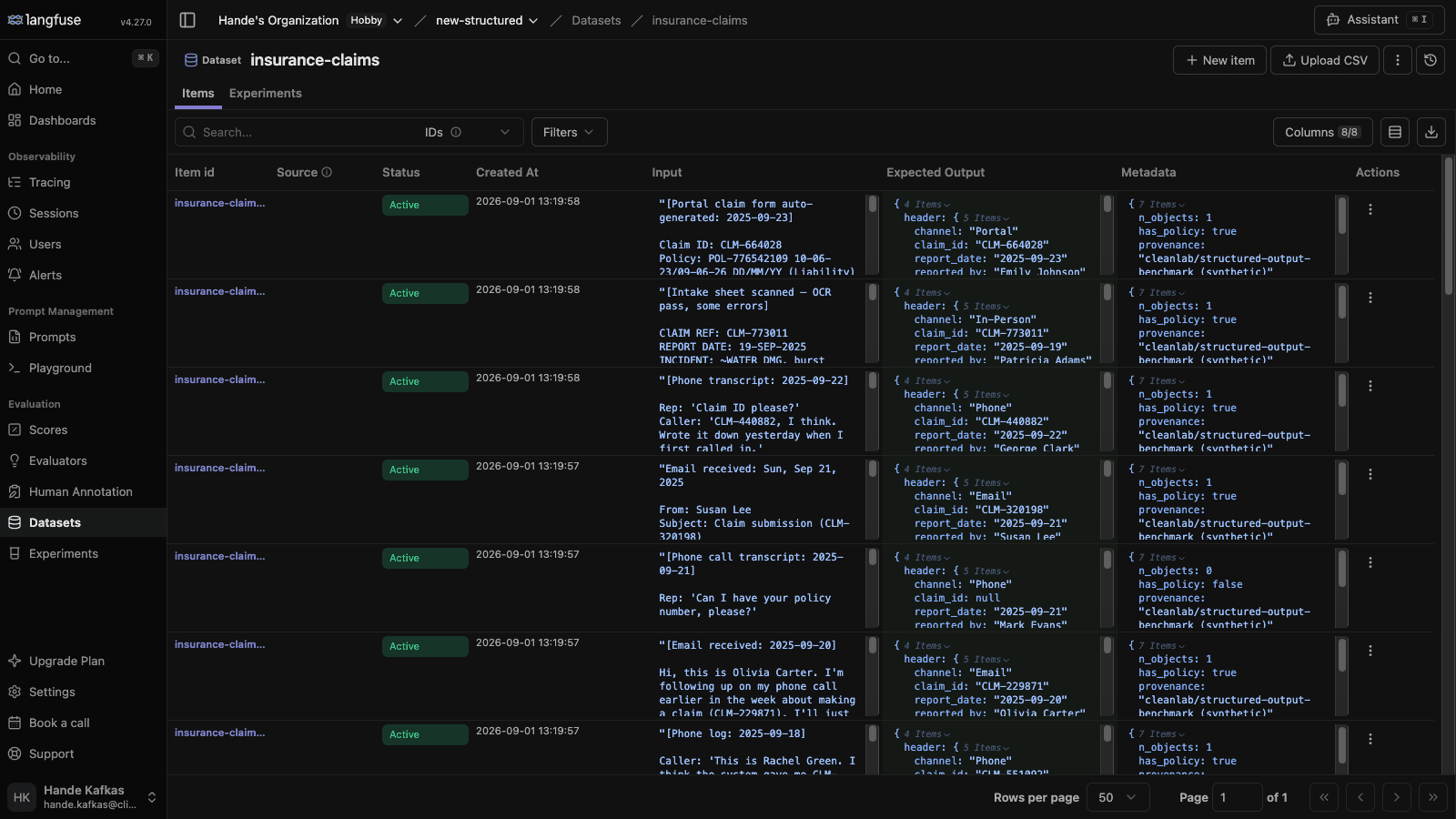
Open Datasets in Langfuse and confirm 30 items. Five claims have no policy and no objects. 11 of 27 labeled objects have a null object_id. One claim has a null claim_id. The labels are not schema-valid. That is the point of the later ID-format scores.
4. Score every field, then overall
The scorer walks each leaf and emits a boolean per path (field.header.claim_id, field.policy_details.policyholder_name, ...) plus field_accuracy_overall. A separate valid_json score catches LLM output parsing failures. A response that does not parse gets no field scores at all.
The comparison is type-aware. Dates match on the parsed value, so 2025-09-23 and September 23, 2025 are the same answer. Amounts match within a small tolerance (1.0 absolute or 1%), while year must match exactly because a 1% window on a year spans two decades. Because insured_objects is a list, the scorer first pairs labeled objects with predicted objects by field similarity, then scores fields inside each pair, so ordering differences cost nothing. Nulls are handled two ways. When a required field is null in the labels, that is a labeling gap and the leaf is skipped. When an optional field is null in the labels, the document genuinely omits the value, so the model must also output null, and inventing one counts as wrong.
The scorer adapts Cleanlab's
utils.pycomparison (per-section matching, normalized strings, object pairing) and adds typed date/number matching.
Run the evaluator wrapper after this block. Expand only if you want compare_claim and object pairing.
Scorer implementation
import re
from datetime import date, datetime
from itertools import combinations, permutations

OPTIONAL_LEAVES = {"header": set(), "policy_details": set(),
    "insured_objects": {"make_model", "year", "location_address", "estimated_value"},
    "incident_description": {"estimated_damage_amount", "police_report_number"}}
DATE_FIELDS = {"header.report_date", "header.incident_date",
               "policy_details.effective_date", "policy_details.expiration_date"}
NUMERIC_FIELDS = {"incident_description.estimated_damage_amount",
                  "insured_objects.year", "insured_objects.estimated_value"}
EXACT_NUMERIC_FIELDS = {"insured_objects.year"}
ENUM_FIELDS = {"header.channel", "policy_details.coverage_type", "insured_objects.object_type",
               "incident_description.incident_type", "incident_description.location_type"}
ID_REGEX = {"header.claim_id": r"^CLM-\d{6}$", "policy_details.policy_number": r"^POL-\d{9}$"}
OBJECT_ID_REGEX = {"Vehicle": r"^VIN[A-Z0-9]{17}$", "Building": r"^PROP-\d{6}$",
                   "Person": r"^(LIAB|OBJ)-\d{6}$", "Other": r"^(LIAB|OBJ)-\d{6}$"}
NUMERIC_ABS_TOL, NUMERIC_REL_TOL, OBJECT_MATCH_THRESHOLD = 1.0, 0.01, 0.5
_EMPTY_SECTION = dict(correct=0, total=0, enum_c=0, enum_t=0, date_c=0, date_t=0,
                      num_c=0, num_t=0, leaf_results=[])

def norm_str(v):
    s = re.sub(r"[^\w\s]", "", str(v).strip().lower())
    return re.sub(r"\s+", "", s)

def to_date(v):
    if isinstance(v, date):
        return v
    s = str(v).strip()
    try:
        return date.fromisoformat(s[:10])
    except ValueError:
        for fmt in ("%m/%d/%Y", "%d/%m/%Y", "%B %d, %Y", "%b %d, %Y", "%Y/%m/%d"):
            try:
                return datetime.strptime(s, fmt).date()
            except ValueError:
                continue
    return None

def match_date(gt, pred):
    a, b = to_date(gt), to_date(pred)
    return a == b if (a and b) else norm_str(gt) == norm_str(pred)

def match_number(gt, pred, exact=False):
    try:
        g, p = float(gt), float(pred)
    except (TypeError, ValueError):
        return norm_str(gt) == norm_str(pred)
    if exact:
        return g == p
    return abs(g - p) <= max(NUMERIC_ABS_TOL, NUMERIC_REL_TOL * abs(g))

def match_value(path, gt, pred):
    if path in DATE_FIELDS:
        return match_date(gt, pred)
    if path in NUMERIC_FIELDS:
        return match_number(gt, pred, exact=path in EXACT_NUMERIC_FIELDS)
    return norm_str(gt) == norm_str(pred)   # enums + free strings

def is_optional(section, field):
    return field in OPTIONAL_LEAVES.get(section, set())

def compare_section(section, gt, pred, path_prefix=None):
    pred = pred or {}
    correct = total = enum_c = enum_t = date_c = date_t = num_c = num_t = 0
    leaf_results = []
    prefix = path_prefix or section
    for field, gt_val in gt.items():
        path = f"{section}.{field}"
        leaf_path = f"{prefix}.{field}"
        if gt_val is None:
            if not is_optional(section, field):
                continue                       # required + null => not gradable (data gap)
            ok = pred.get(field) is None
            total += 1; correct += int(ok)
            leaf_results.append((leaf_path, bool(ok)))
            continue
        ok = (pred.get(field) is not None) and match_value(path, gt_val, pred.get(field))
        total += 1; correct += int(ok)
        leaf_results.append((leaf_path, bool(ok)))
        if path in ENUM_FIELDS:   enum_t += 1; enum_c += int(ok)
        elif path in DATE_FIELDS: date_t += 1; date_c += int(ok)
        elif path in NUMERIC_FIELDS: num_t += 1; num_c += int(ok)
    return dict(correct=correct, total=total, enum_c=enum_c, enum_t=enum_t,
                date_c=date_c, date_t=date_t, num_c=num_c, num_t=num_t,
                leaf_results=leaf_results)

def object_similarity(gt_obj, pred_obj):
    r = compare_section("insured_objects", gt_obj, pred_obj)
    return r["correct"] / r["total"] if r["total"] else 0.0

def optimal_pairing(gt_objs, pred_objs):
    # pairing[i] = index in pred matched to gt[i] (or None), maximizing similarity.
    n_gt, n_pred = len(gt_objs), len(pred_objs)
    if not n_gt or not n_pred:
        return [None] * n_gt
    if max(n_gt, n_pred) > 6:                  # greedy fallback (never hit on this data)
        used, pairing = set(), []
        for g in gt_objs:
            best, bi = -1.0, None
            for j, p in enumerate(pred_objs):
                if j in used:
                    continue
                s = object_similarity(g, p)
                if s > best:
                    best, bi = s, j
            if bi is not None:
                used.add(bi)
            pairing.append(bi)
        return pairing
    sim = [[object_similarity(g, p) for p in pred_objs] for g in gt_objs]
    best_score, best = -1.0, [None] * n_gt
    for k in range(min(n_gt, n_pred) + 1):
        for gt_idx in combinations(range(n_gt), k):
            for pred_idx in permutations(range(n_pred), k):
                pairing, score = [None] * n_gt, 0.0
                for a, gi in enumerate(gt_idx):
                    pairing[gi] = pred_idx[a]; score += sim[gi][pred_idx[a]]
                if score > best_score:
                    best_score, best = score, pairing
    return best

def score_objects(gt_objs, pred_objs):
    gt_objs, pred_objs = gt_objs or [], pred_objs or []
    n_gt, n_pred = len(gt_objs), len(pred_objs)
    leaf_results = [("insured_objects.count", n_gt == n_pred)]
    if n_gt == 0 and n_pred == 0:
        return dict(precision=1.0, recall=1.0, f1=1.0, tp=0, field_correct=0, field_total=0,
                    count_correct=True, counted_gt=set(), leaf_results=leaf_results)
    pairing = optimal_pairing(gt_objs, pred_objs)
    tp = field_correct = field_total = 0
    counted_gt = set()   # gt indices whose fields entered field_correct/field_total
    for gi, gobj in enumerate(gt_objs):
        pj = pairing[gi] if gi < len(pairing) else None
        pred_obj = pred_objs[pj] if pj is not None else {}
        r = compare_section("insured_objects", gobj, pred_obj, path_prefix=f"insured_objects.{gi}")
        leaf_results.extend(r["leaf_results"])
        if pj is None:
            continue
        if (r["correct"] / r["total"] if r["total"] else 0.0) >= OBJECT_MATCH_THRESHOLD:
            tp += 1; field_correct += r["correct"]; field_total += r["total"]
            counted_gt.add(gi)
    precision = tp / n_pred if n_pred else (1.0 if n_gt == 0 else 0.0)
    recall = tp / n_gt if n_gt else (1.0 if n_pred == 0 else 0.0)
    f1 = (2 * precision * recall / (precision + recall)) if (precision + recall) else 0.0
    return dict(precision=precision, recall=recall, f1=f1, tp=tp,
                field_correct=field_correct, field_total=field_total, count_correct=(n_gt == n_pred),
                counted_gt=counted_gt, leaf_results=leaf_results)

def score_id_formats(pred):
    ok = total = 0
    cid = pred.get("header", {}).get("claim_id")
    if cid is not None:
        total += 1; ok += int(bool(re.match(ID_REGEX["header.claim_id"], str(cid))))
    pol = pred.get("policy_details")
    if pol and pol.get("policy_number") is not None:
        total += 1; ok += int(bool(re.match(ID_REGEX["policy_details.policy_number"], str(pol["policy_number"]))))
    for obj in (pred.get("insured_objects") or []):
        oid = obj.get("object_id")
        if oid is None:
            continue
        rgx = OBJECT_ID_REGEX.get(obj.get("object_type"), r"^(OBJ|LIAB)-\d{6}$")
        total += 1; ok += int(bool(re.match(rgx, str(oid))))
    return dict(ok=ok, total=total)

def compare_claim(pred, gt):
    if pred is None:
        return dict(valid_json=False, leaf_results=[])
    header = compare_section("header", gt.get("header", {}), pred.get("header"))
    incident = compare_section("incident_description", gt.get("incident_description", {}), pred.get("incident_description"))
    gt_policy, pred_policy = gt.get("policy_details"), pred.get("policy_details")
    policy = compare_section("policy_details", gt_policy, pred_policy) if gt_policy else dict(_EMPTY_SECTION)
    objs = score_objects(gt.get("insured_objects"), pred.get("insured_objects"))
    leaf_results = list(header["leaf_results"]) + list(incident["leaf_results"])
    if gt_policy:
        leaf_results.extend(policy["leaf_results"])
    else:
        leaf_results.append(("policy_details.present", pred_policy is None))
    leaf_results.extend(objs["leaf_results"])
    f_correct = header["correct"] + incident["correct"] + policy["correct"] + objs["field_correct"]
    f_total = header["total"] + incident["total"] + policy["total"] + objs["field_total"]
    # Objects that never entered field_total still count toward the denominator.
    for gi, gobj in enumerate(gt.get("insured_objects") or []):
        if gi not in objs["counted_gt"]:
            f_total += compare_section("insured_objects", gobj, {})["total"]
    enum_c = header["enum_c"] + incident["enum_c"] + policy["enum_c"]; enum_t = header["enum_t"] + incident["enum_t"] + policy["enum_t"]
    date_c = header["date_c"] + incident["date_c"] + policy["date_c"]; date_t = header["date_t"] + incident["date_t"] + policy["date_t"]
    num_c = header["num_c"] + incident["num_c"] + policy["num_c"]; num_t = header["num_t"] + incident["num_t"] + policy["num_t"]
    pairing = optimal_pairing(gt.get("insured_objects") or [], pred.get("insured_objects") or [])
    for gi, pj in enumerate(pairing):
        if pj is None:
            continue
        r = compare_section("insured_objects", gt["insured_objects"][gi], (pred.get("insured_objects") or [])[pj])
        enum_c += r["enum_c"]; enum_t += r["enum_t"]; num_c += r["num_c"]; num_t += r["num_t"]
    ids = score_id_formats(pred)
    presence = [bool(gt_policy) == bool(pred_policy), bool(gt.get("insured_objects")) == bool(pred.get("insured_objects"))]
    ratio = lambda c, t: (c / t) if t else None
    return dict(valid_json=True, leaf_results=leaf_results,
        field_accuracy_overall=ratio(f_correct, f_total), header_accuracy=ratio(header["correct"], header["total"]),
        policy_accuracy=ratio(policy["correct"], policy["total"]), incident_accuracy=ratio(incident["correct"], incident["total"]),
        enum_accuracy=ratio(enum_c, enum_t), date_accuracy=ratio(date_c, date_t),
        numeric_accuracy=ratio(num_c, num_t), id_format_ok=ratio(ids["ok"], ids["total"]),
        objects_count_correct=objs["count_correct"], objects_precision=objs["precision"], objects_recall=objs["recall"],
        objects_f1=objs["f1"], object_field_accuracy=ratio(objs["field_correct"], objs["field_total"]),
        section_presence_correct=sum(presence) / len(presence))
from langfuse import Evaluation

def extraction_evaluator(*, output, expected_output, **kwargs):
    if not isinstance(output, dict):
        return [Evaluation(name="valid_json", value=False, data_type="BOOLEAN")]

    breakdown = compare_claim(output.get("prediction"), expected_output)
    evals = [Evaluation(name="valid_json", value=bool(breakdown.get("valid_json")), data_type="BOOLEAN")]

    for path, ok in breakdown.get("leaf_results") or []:
        evals.append(Evaluation(name=f"field.{path}", value=bool(ok), data_type="BOOLEAN"))

    if breakdown.get("valid_json"):
        overall = breakdown.get("field_accuracy_overall")
        evals.append(Evaluation(
            name="field_accuracy_overall",
            value=float(overall) if overall is not None else 0.0,
            data_type="NUMERIC",
        ))
        if breakdown.get("objects_f1") is not None:
            evals.append(Evaluation(name="objects_f1", value=float(breakdown["objects_f1"]), data_type="NUMERIC"))
    return evals

def run_aggregates(*, item_results, **kwargs):
    from collections import defaultdict
    vals = defaultdict(list)
    for ir in item_results:
        for ev in (getattr(ir, "evaluations", None) or []):
            name = ev.get("name") if isinstance(ev, dict) else getattr(ev, "name", None)
            value = ev.get("value") if isinstance(ev, dict) else getattr(ev, "value", None)
            if name is not None and isinstance(value, (int, float, bool)):
                vals[name].append(float(value))
    return [Evaluation(name=f"mean_{name}", value=sum(xs) / len(xs), data_type="NUMERIC")
            for name, xs in vals.items() if xs]
Each experiment item in Langfuse gets those field.* scores. Sort failing items by a field path rather than by overall accuracy.
5. Run experiments from the dataset
run_round calls dataset.run_experiment and appends a row to a comparison table: overall field accuracy, object_id, policyholder_name, and objects_F1. Re-running a cell starts a new experiment run; Langfuse keeps every run on the Experiments tab as history.
Prompts live in Langfuse as extraction-system. The next cell creates v1.
from functools import lru_cache
from langfuse.openai import openai
import time

PROMPT_NAME = "extraction-system"
TERSE_V1 = "Extract the insurance claim from the text into the structured schema."

@lru_cache(maxsize=16)
def get_system_prompt(version):
    return langfuse.get_prompt(PROMPT_NAME, version=version)

def seed_prompt(version, text, labels, commit_message):
    # Idempotent: prompt versions are immutable, so only create what doesn't exist yet.
    metas = langfuse.api.prompts.list(name=PROMPT_NAME).data
    if any(version in (m.versions or []) for m in metas):
        existing = langfuse.get_prompt(PROMPT_NAME, version=version)
        if existing.prompt.strip() != text.strip():
            raise RuntimeError(
                f"'{PROMPT_NAME}' v{version} already exists with different text. This project "
                f"has an unrelated prompt under that name; change PROMPT_NAME or use a fresh project.")
        print(f"prompt v{version} already exists")
        return
    langfuse.create_prompt(name=PROMPT_NAME, prompt=text, type="text",
                           labels=labels, commit_message=commit_message)
    get_system_prompt.cache_clear()
    print(f"created prompt v{version}")

# Seed v1 (terse baseline). Later we'll add v2/v3 when the results tell us to.
seed_prompt(1, TERSE_V1, ["baseline"], "v1: terse baseline")
def build_messages(system_text, claim_text):
    return [{"role": "system", "content": system_text},
            {"role": "user", "content": claim_text}]

def extract(cfg, claim_text, name):
    system_text = TERSE_V1 if cfg["prompt_version"] is None else get_system_prompt(cfg["prompt_version"]).compile()
    prompt_obj = None if cfg["prompt_version"] is None else get_system_prompt(cfg["prompt_version"])
    t0 = time.perf_counter()
    c = openai.chat.completions.parse(
        model=cfg["model"],
        messages=build_messages(system_text, claim_text),
        response_format=SCHEMAS[cfg["schema"]],
        name=name, langfuse_prompt=prompt_obj, temperature=0)
    parsed = c.choices[0].message.parsed
    return {"prediction": parsed.model_dump(mode="json") if parsed else None,
            "valid_json": parsed is not None, "latency_ms": (time.perf_counter() - t0) * 1000,
            "model": cfg["model"]}
import pandas as pd

def ev_dict(evs):
    return {getattr(e, "name", None): getattr(e, "value", None) for e in (evs or [])}

def _mean(rows, name):
    xs = [float(r[name]) for r in rows if isinstance(r.get(name), (int, float, bool))]
    return sum(xs) / len(xs) if xs else None

def _mean_field_suffix(rows, suffix):
    xs = []
    for r in rows:
        for name, value in r.items():
            if not (isinstance(name, str) and name.startswith("field.")):
                continue
            path = name[len("field."):]
            if path == suffix or path.endswith("." + suffix):
                if isinstance(value, (int, float, bool)):
                    xs.append(float(value))
    return sum(xs) / len(xs) if xs else None

def worst_fields(run, top=10):
    from collections import defaultdict
    hits = defaultdict(lambda: [0, 0])
    for ir in run.item_results:
        for ev in (getattr(ir, "evaluations", None) or []):
            name = ev.get("name") if isinstance(ev, dict) else getattr(ev, "name", None)
            value = ev.get("value") if isinstance(ev, dict) else getattr(ev, "value", None)
            if name and name.startswith("field.") and isinstance(value, (int, float, bool)):
                hits[name][1] += 1
                hits[name][0] += int(bool(value))
    ranked = sorted(hits.items(), key=lambda kv: (kv[1][0] / kv[1][1] if kv[1][1] else 1.0, kv[0]))
    print("lowest field accuracies:")
    for name, (ok, n) in ranked[:top]:
        print(f"  {name}: {ok}/{n} ({ok / n:.2f})")

results, summaries = {}, []

def _round(x):
    return None if x is None else round(x, 3)

def run_round(name, *, model="gpt-4o-mini", schema="descriptive", prompt_version=None):
    cfg = dict(model=model, schema=schema, prompt_version=prompt_version)
    def task(*, item, **kwargs):
        return extract(cfg, item.input, name)
    res = dataset.run_experiment(
        name=name, task=task, evaluators=[extraction_evaluator],
        run_evaluators=[run_aggregates], max_concurrency=8)
    langfuse.flush()
    results[name] = res
    rows = [ev_dict(ir.evaluations) for ir in res.item_results]
    summary = {
        "variant": name,
        "valid_json%": _round(_mean(rows, "valid_json")),
        "field_acc": _round(_mean(rows, "field_accuracy_overall")),
        "object_id": _round(_mean_field_suffix(rows, "object_id")),
        "policyholder": _round(_mean_field_suffix(rows, "policyholder_name")),
        "objects_F1": _round(_mean(rows, "objects_f1")),
    }
    for i, s in enumerate(summaries):
        if s["variant"] == name:
            summaries[i] = summary
            break
    else:
        summaries.append(summary)
    return comparison_table()

def comparison_table():
    cols = ["variant", "valid_json%", "field_acc", "object_id", "policyholder", "objects_F1"]
    return pd.DataFrame([{k: s[k] for k in cols} for s in summaries])
You should see created prompt v1 or prompt v1 already exists. Open Prompts in Langfuse if you want to read the terse baseline.
6. Baseline: bare schema, terse prompt
Run gpt-4o-mini with the bare schema and prompt v1. After it finishes, read the table and worst_fields. field_acc will look high. The field list is the point.
run_round("V1_baseline", model="gpt-4o-mini", schema="bare", prompt_version=1)
worst_fields(results["V1_baseline"])
Open the experiment in Langfuse and sort failing items by a low-scoring field rather than by the overall score.
worst_fields usually ranks make_model first, then dates and object_id (each field is defined in the schema in section 2). On this dataset the object_id misses are often dropped prefixes (PROP-656048 becomes 656048) rather than invented 1 / 2. The next cell only changes the schema, which can teach those prefixes. make_model may move as a side effect. That is not the lever you are testing.
At n=30, a 3-point move can be one document. Pick the next change from the field list instead of the pooled average.
7. Add schema descriptions
Same prompt, same model. Only the schema changes (bare to descriptive). Watch object_id.
run_round("V2_schema_spec", model="gpt-4o-mini", schema="descriptive", prompt_version=1)
worst_fields(results["V2_schema_spec"])
Compare the new object_id column to V1. Then open Compare for the two runs: select both experiments on the dataset's Experiments tab and click Compare (see Experiments via UI). Each row is a claim; each run gets a column with its output and the per-field scores next to it.
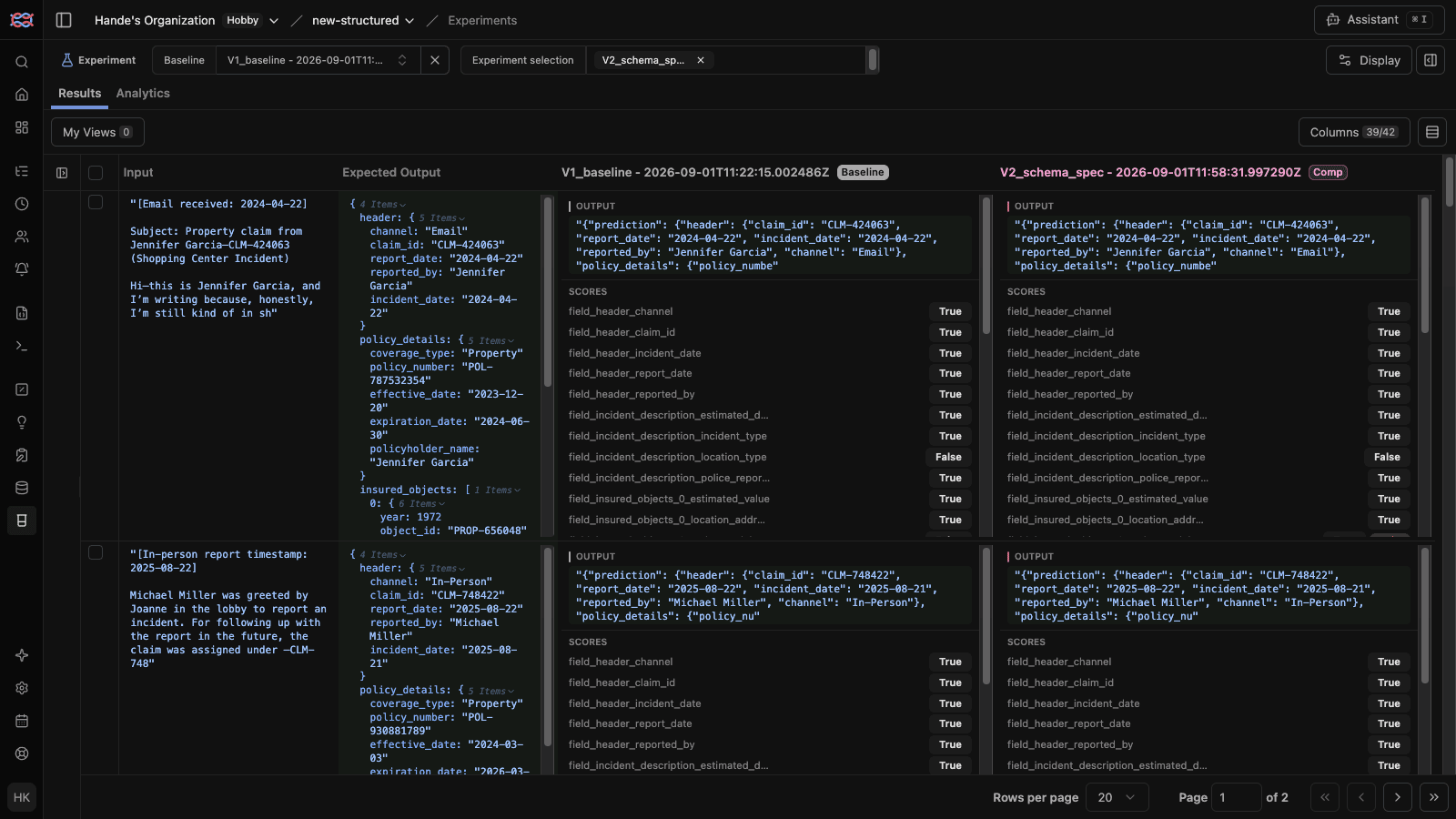
In your table, check whether object_id improved. In the traces, separate a real ID that gained a prefix from a well-formatted ID that was invented because the schema requires object_id while 11 labels are null.
Open one of each if you can. The later schema fix is to make object_id optional.
If an item has a null label and a VIN/PROP id in the output, that value came from the schema forcing a string rather than from the document.
8. Add prompt rules
Same descriptive schema. The only change is prompt v2. Watch objects_F1 and policyholder.
RULES_V2 = """\
Extract the insurance claim into the structured schema. Follow these rules:
- IDs: claim_id must match CLM-XXXXXX (6 digits); policy_number must match POL-XXXXXXXXX (9 digits).
  For insured objects use the format implied by object_type: VINxx... for vehicles, PROP-XXXXXX for
  buildings, LIAB-XXXXXX for liability, OBJ-XXXXXX otherwise.
- Dates: output ISO 8601 (YYYY-MM-DD).
- Enums: choose the single closest standardized value; never invent new enum values.
- Do NOT invent information. If policy details are not present in the text, omit policy_details.
  If no insured objects are described, omit insured_objects. Leave optional fields null when absent.
- Extract values verbatim where possible; do not normalize names beyond what the schema requires."""


seed_prompt(2, RULES_V2, ["production"], "v2: explicit rules")
run_round("V3_prompt_rules", model="gpt-4o-mini", schema="descriptive", prompt_version=2)
worst_fields(results["V3_prompt_rules"])
Watch objects_F1 if "do not invent objects" landed. Then check policyholder. A verbatim / don't-invent rule can replace a present name with /null. That is the regression pooled field_acc will hide.
In Langfuse, open the same claim on V2 and V3 and compare field.policy_details.policyholder_name.
If V3 shows /null or a truncated name where V2 had the full name, per-field scoring is what caught it. The pooled average would have hidden it.
9. Inspect the V3 failures
drill_into prints location_type confusions, remaining bad object_ids, and placeholder names. Use that list to write the next prompt version.
The next cell lists enum confusions, bad object_ids, and placeholder names. Expand for the helper.
Drill-down audit
from collections import Counter

def enum_confusion(run, field_path):
    section, field = field_path.split(".", 1)
    conf = Counter()
    for ir in run.item_results:
        gt = ir.item.expected_output
        pred = ir.output.get("prediction") if isinstance(ir.output, dict) else None
        g = (gt.get(section) or {}).get(field) if gt else None
        p = (pred.get(section) or {}).get(field) if pred else None
        if g is not None:
            conf[(g, p if p is not None else "<missing>")] += 1
    return conf

def drill_into(run, label):
    print(f"{label} location_type confusions (ground_truth -> predicted):")
    for (g, p), n in sorted(enum_confusion(run, "incident_description.location_type").items(), key=lambda x: -x[1]):
        if g != p:
            print(f"  {g} -> {p}: {n}")
    print(f"\n{label} object_id format misses:")
    for ir in run.item_results:
        pred = ir.output.get("prediction") if isinstance(ir.output, dict) else None
        for obj in ((pred or {}).get("insured_objects") or []):
            oid, ot = obj.get("object_id"), obj.get("object_type")
            rgx = OBJECT_ID_REGEX.get(ot, r"^(OBJ|LIAB)-\d{6}$")
            if oid and not re.match(rgx, str(oid)):
                print(f"  {ot}: {oid!r}")
    print(f"\n{label} policyholder_name regressions (placeholder / truncated):")
    for ir in run.item_results:
        pred = ir.output.get("prediction") if isinstance(ir.output, dict) else None
        name = ((pred or {}).get("policy_details") or {}).get("policyholder_name")
        if name and (str(name).strip("/").lower() in ("null", "na", "") or len(str(name).split()) < 2):
            print(f"  {getattr(ir.item, 'id', '?')}: policyholder_name={name!r}")
drill_into(results["V3_prompt_rules"], "V3")
If you see placeholder names, that is the V3 regression. The next cell saves a new prompt version instead of editing v2.
10. New prompt version, same dataset
Prompt versions are immutable. Add two rules: copy policyholder_name exactly, and only emit objects that are actually described. Save as v3 and rerun.
RULES_V3 = RULES_V2 + """
- policyholder_name: copy the policyholder's full name exactly as written. NEVER output 'null', 'NA',
  '/', or any placeholder for a field that IS present.
- Insured objects: only emit an object explicitly described as insured or damaged. If none are, return
  an empty list — do NOT invent one to fill an id. When an object exists, its object_id uses the real
  value/format for its type; never copy the literal 'xxxx' placeholder."""


seed_prompt(3, RULES_V3, ["candidate"], "v3: copy name verbatim; stop re-inventing objects")
run_round("V3_fixed", model="gpt-4o-mini", schema="descriptive", prompt_version=3)
worst_fields(results["V3_fixed"])
The run should link to extraction-system v3 in Prompt Management. All three versions stay in the history, so every experiment stays attributable to the exact prompt text it ran with.
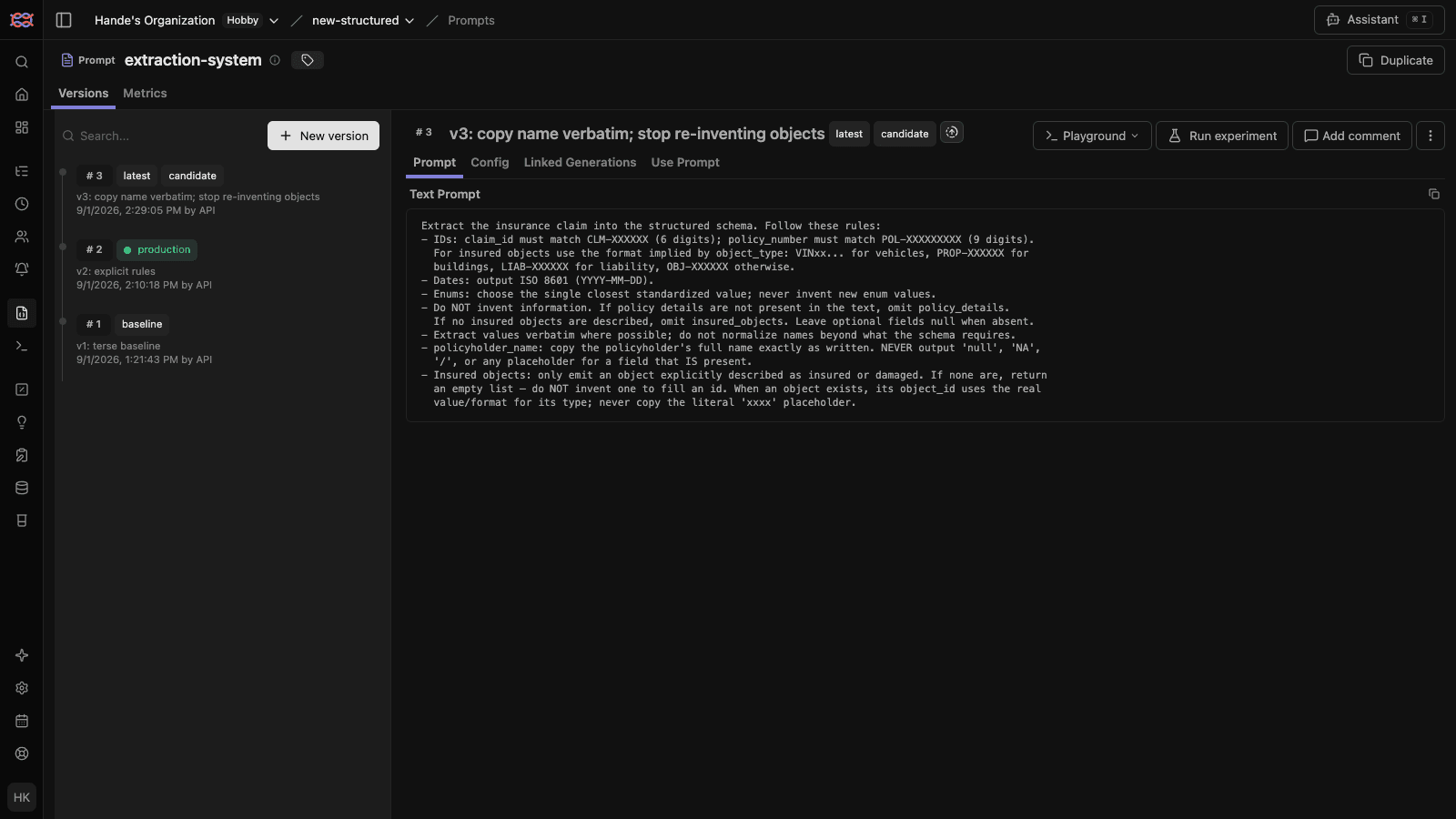
Read the policyholder column rather than the headline field_acc. The field you fixed is the one that matters.
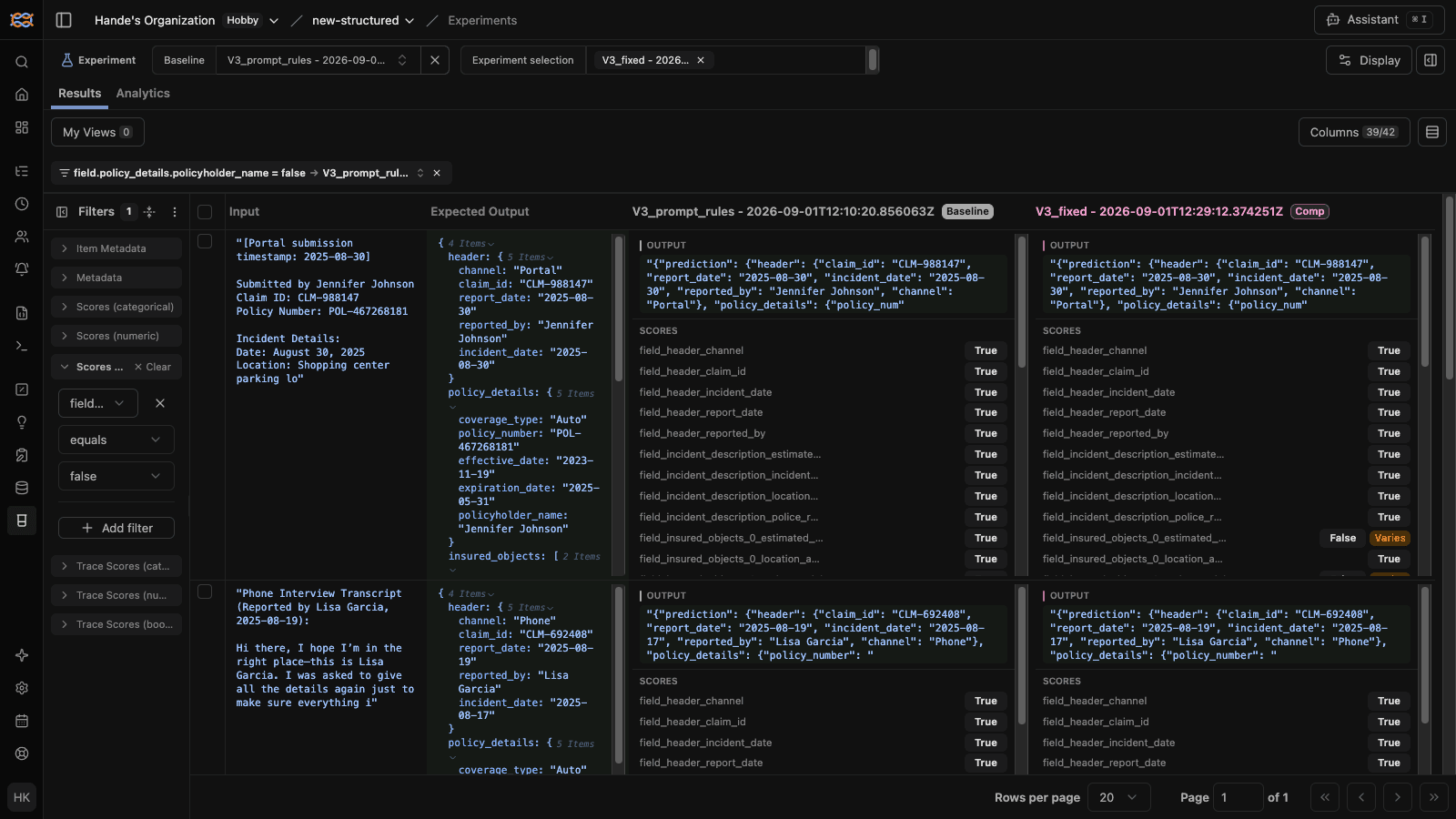
To verify the fix in Langfuse, compare V3 and V3_fixed and filter Scores (boolean) to field.policy_details.policyholder_name = false on the V3 baseline. Only the regressed claims remain, and the V3_fixed column shows the restored names next to them.
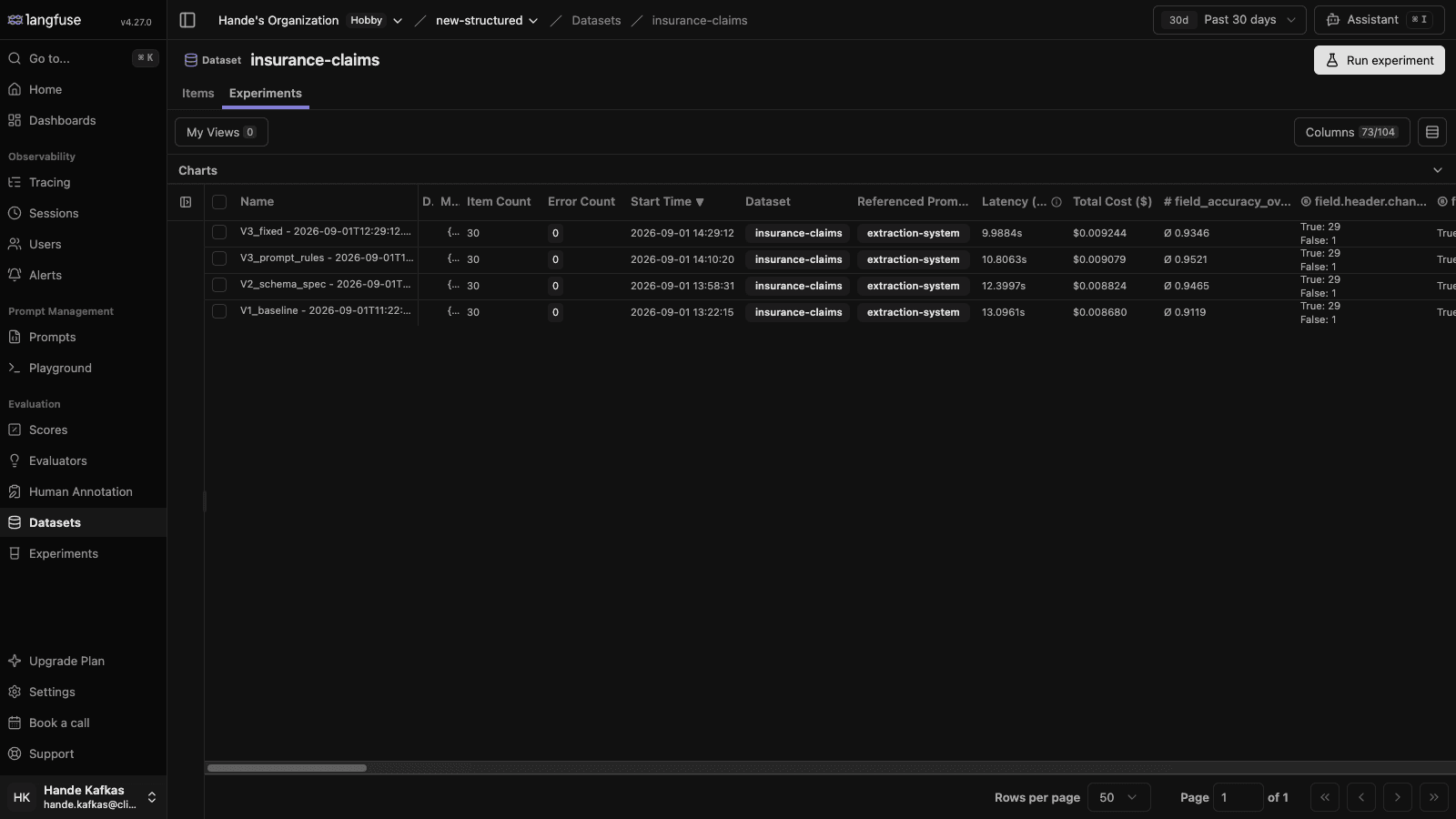
The dataset's Experiments tab now shows all four runs in one table with cost, latency, and mean field accuracy. In the run pictured, V3_fixed's headline mean (0.93) is below V3's (0.95) even though the field you targeted recovered. Your exact numbers will vary, but the same inversion is common. Anyone reading only the single number would call the fix a regression. That is the whole argument for per-field scores.
11. Grow the set, freeze a holdout, run in CI
n=30 is enough to learn the loop but not enough to ship on. Once you have a real labeled set:
- Add production traces as dataset items, and synthetic items for rare slices.
- Freeze a holdout dataset and stop tuning against it. Every rule in this notebook came from staring at failures in these 30 items. That is how the loop should work, but if you keep going long enough, the prompt gradually adapts to the quirks of these specific claims. Scores on the tuning set keep improving while production accuracy stays flat. To catch this, set aside items that you never inspect while tuning and score them only to check whether an improvement holds up. If a change helps on the tuning set but does nothing on the holdout, it has overfit.
- Put
run_roundin CI so a prompt edit cannot silently regressfield.policy_details.policyholder_name.
This notebook uses text claims. The same dataset and experiment loop works for multi-modal items when you have those labels.
Cost and latency already live on the experiment run in Langfuse. Read them there.
Last updated on
